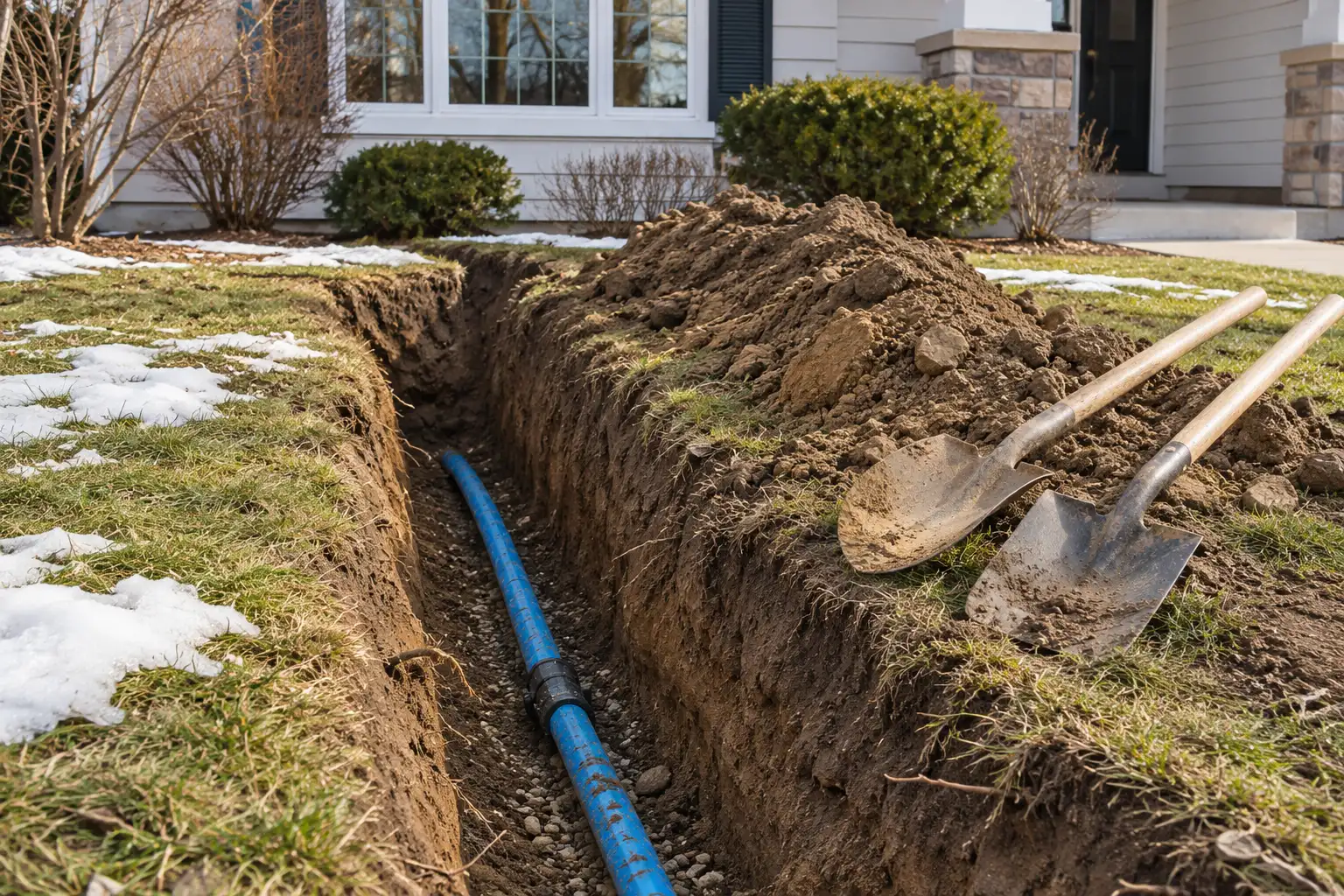
Water Line Repair in Twin Falls, ID
If the yard stays soggy, the pressure drops or the meter spins with every tap closed, the buried water line may be leaking, so call us for a repair.
The pipe you never see until it leaks
Your water line runs underground from the meter by the curb to the spot where it enters your house. Water line repair in Twin Falls usually starts when that hidden pipe begins to leak or freeze, often weeks before anyone notices.
- Curb to houseThe stretch the homeowner usually looks after.
- Leaks you cannot seeA soggy lawn, weak flow or a meter that keeps moving.
- Shallow spots freezeWhere the line rises toward the foundation.
Signs the buried line is leaking
- A meter that keeps turning
- Close every tap, then watch the meter dial for ten minutes. Any movement means water is escaping somewhere.
- A soggy patch of lawn
- Ground that stays wet in dry weather, or grass that grows greener in one strip, often sits above the leak.
- Low pressure at every tap
- When every faucet in the house weakens at once, the problem often lies before the water reaches the fixtures.
- A sinking spot or a small hole
- Water washing soil away underground can leave a dip in the yard or the driveway edge.
- Sputtering faucets
- Air in the line can mean the pipe has a break where it pulls in air and dirt.

Why a house ends up needing water line repair
Most water lines fail from age, ground movement or frost. Older galvanized lines rust from the inside, copper lines can wear thin, and plastic lines can crack where they meet a fitting.
Frost that reaches deep enough can freeze a line that runs too shallow, and the ground shifting through freeze and thaw cycles puts strain on joints.
- Corrosion that narrows and weakens older metal pipe
- Joints and fittings loosened by shifting soil
- Shallow sections that freeze in a hard winter
- Tree roots that press against or crack the line
From the first sign to a repaired line
Prove the line is losing water
Meter and pressure readings show whether water is escaping between the curb and the house.
Locate the break
The leak is traced along the route of the line so only the damaged part needs digging.
Mend or renew
One bad stretch can be mended, while a line that fails again and again is often better renewed.
Test and backfill
Water is restored, the joint is checked under pressure and the trench is filled.
Repair a section or replace the whole line
Which repair makes sense depends on the age of the pipe and how often it has leaked.
What belongs to you and what belongs to the city
In most cases the homeowner owns the stretch from the meter to the house, while the city looks after the side between the main and the meter. If you are not sure where the leak is, the plumber can help work out which side it sits on.
If water is bubbling up near the meter box itself, it is worth calling the city water department as well, since the leak may be on their side.
What a buried leak does if it is left
A leak in the water line rarely fixes itself. Left alone, it keeps working on the ground around it, and the damage spreads well beyond the pipe.
It wastes water around the clock
Water escapes day and night, whether anyone is home or not, and the meter records all of it.
It softens the ground
Soil washed away underground can leave hollows under walkways, driveways and the lawn.
It can reach the foundation
A leak close to the house can keep the soil against the foundation wet for months.
It drags the pressure down
The more water the leak takes, the weaker every shower and faucet in the house becomes.
Water line questions
- How would a leak in the water line show itself?
Turn off every tap and every appliance that uses water, then watch the meter for ten minutes. If the dial or the small flow indicator keeps moving, water is escaping somewhere.
When the inside of the house is dry, the buried line between the meter and the house becomes the likely place to look.
- Will the plumber have to dig up the entire yard?
The whole yard is rarely dug up. Water line repair in Twin Falls starts with locating the leak along the route of the line, so only the area around the damaged section needs to be opened. Careful locating before digging is what keeps the repair small and the lawn mostly intact.
- Why is my water pressure suddenly low everywhere?
Low pressure at every tap at once can point to a leak in the main line, a valve that has been partly closed or rust narrowing an older pipe.
A plumber checks each of these in turn, starting with the simplest, and measures the pressure where the line enters the house.
- Can a water line freeze underground?
Yes, if it runs shallow or passes close to a cold foundation wall where frost reaches it.
A line that freezes every winter may need to be lowered below the frost, insulated where it enters the house or protected with heat cable at the exposed section.
- Who fixes the pipe near the meter?
The city usually handles the meter and the line from the street main to the meter. The line from the meter to your house is normally the homeowner’s responsibility. If water bubbles up right at the meter box, call the city as well.
- How long does a water line repair take?
A short section near the surface can often be repaired within a single visit. A longer replacement takes more time because the trench is longer and the new line has to be tested under pressure before it is covered.
- Is there running water during the repair?
The supply stays off while the damaged section is cut away and new pipe goes in. The plumber tells you how long that will take ahead of time, so you can fill some jugs to drink and wash with.
- What material is a new water line made from?
Most new service lines are copper or a plastic such as PEX or polyethylene, depending on the length, the soil and local rules. The plumber explains which suits your yard and why.
- Does a new water line improve water pressure?
Often, yes, when the old line was rusted inside or undersized. Replacing it restores the full flow from the meter to the house, which every faucet and shower feels.
Other repairs for pipes and water lines
Meter still spinning? Call us.
A licensed Twin Falls plumber can confirm the leak, find it and repair the line.
Confirm it
Meter and pressure checks show the leak.
Find it
The break is traced before anyone digs.
Fix it
Repair or replacement, with a pressure test.