Why Does My Toilet Keep Running?
A toilet that keeps running nearly always has one of three causes, and you can check all three in a few minutes with the tank lid off.
Why does my toilet keep running after a flush?
If you have ever asked why does my toilet keep running, the answer is that water is escaping from the tank and the fill valve keeps adding more to replace it. The sound is the refill that never finishes.
Water escapes in one of two ways. Either it leaks past the flapper into the bowl, or the water level rises so high that it spills into the overflow tube.
- A worn or warped flapper that no longer seals
- A float set too high, so water spills into the overflow tube
- A fill valve that never quite closes
- A chain that is too short and holds the flapper open
Check the tank in five minutes
Take off the lid
Set it on a towel on the floor, since tank lids crack easily.
Look at the water level
Set the water so it stops a finger width below the opening of the overflow tube.
Watch the flapper
After a flush it should drop and seal cleanly over the opening.
Check the chain
Leave it slightly loose, though never so loose that it can catch under the flapper.
Run the dye test
Squeeze some food coloring into the tank, then leave the toilet unflushed for fifteen minutes.
What your toilet is telling you
Replacing a flapper yourself
A flapper is the most common fix and one of the simplest.
Shut the small valve at the wall, flush once so the tank drains, and unhook the old flapper from the pegs on the overflow tube. Take it with you so the new one matches.
Hook the new flapper on, attach the chain with a little slack and open the supply valve. A toilet that keeps running after this points to the fill valve, and our toilet repair page explains what a plumber checks.
- Close the supply at the wall before anything else
- Buy a flapper that matches the size and style of the old one
- Repeat the dye test afterward to confirm the seal holds
Why it is worth fixing quickly
A running toilet wastes water every hour of the day. Over a month that can add up to a surprising amount, and the constant refill wears out the fill valve faster.
A toilet that keeps running can also hide a second problem. If the bowl rocks or water appears at the base, the wax seal may be failing too, and our leak detection page explains how hidden leaks are found.
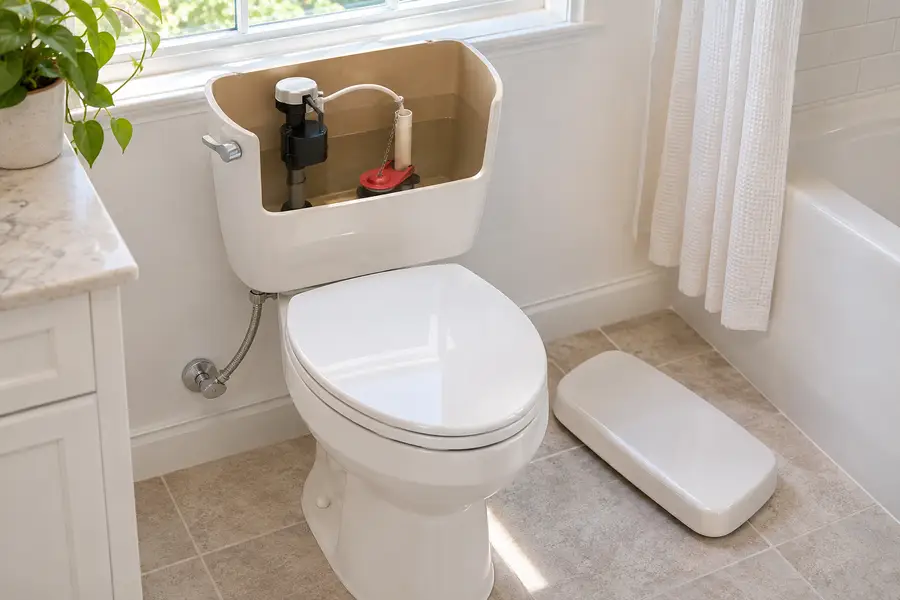
The parts inside a toilet tank
Knowing the parts by name makes the checks above much easier, and helps when you describe the problem on the phone.
- Fill valve
- The tall valve on one side that lets water into the tank after a flush and shuts off when the tank is full.
- Float
- A cup or ball that rises with the water and tells the fill valve when to stop.
- Overflow tube
- The open pipe in the middle that sends extra water into the bowl so the tank cannot overflow.
- Flapper
- The rubber seal at the bottom that lifts to flush and drops back to hold water in the tank.
- Chain and handle
- The handle lifts the flapper through the chain, which needs just a little slack.
Small habits that keep a toilet quiet
Listen after each flush
A refill that keeps hissing for more than a minute is worth a look.
Run the dye test twice a year
A few drops of color catch slow flapper leaks before they waste much water.
Avoid tank tablets
Some cleaning tablets in the tank wear out rubber flappers faster.
Turn the supply valve now and then
A valve that moves easily is ready when you need to close it.
Replacing a fill valve when the flapper is not the problem
If the dye test shows no leak into the bowl but the toilet still hisses or refills slowly, the fill valve is the likely cause. Fill valves wear out from constant use and from grit in the water.
Replacement starts the same way as a flapper. Close the supply valve, flush and sponge out the last of the water. Disconnect the supply line under the tank, unscrew the nut holding the old valve and lift it out.
The new valve goes in at the same height, with its refill tube clipped to the overflow tube. Open the supply slowly, check for drips under the tank and set the water level with the adjustment on the float.
If the nut under the tank will not loosen, or the supply line looks corroded, stop there. Forcing old parts can crack the tank, and a plumber can finish the job safely.
Fix it yourself or call a plumber
Most running toilets are a simple home repair. A few are better handed over.
Call a plumber
- The supply valve behind the toilet will not turn or leaks
- The tank is cracked or water drips from the tank bolts
- Water appears on the floor around the base
- The toilet still runs after a new flapper and fill valve
Usually a home repair
- The dye test shows color in the bowl
- The chain catches under the flapper
- The float is set high, so water keeps spilling down the overflow
- The flapper looks warped or feels slimy
Still running? More answers
- Why does my toilet keep running even with a new flapper?
The new flapper may not fit the flush valve exactly, the chain may be too tight, or the fill valve may be letting water spill into the overflow tube.
Check the water level first, then the chain, then the fit of the flapper itself.
- How do I lower the water level in the tank?
Most modern fill valves have an adjustment screw or clip on the float. Turn or slide it so the float sits lower, then flush and check that the water now stops a finger width below the overflow opening.
- Can a running toilet raise my water use?
Yes. A toilet that never stops refilling sends water down the drain all day and night.
Fixing it is one of the quickest ways to cut wasted water in the house.
- Is a running toilet urgent?
It is not an emergency, but it is worth fixing soon. If the toilet also leaks at the base or the bowl overflows, call right away. Our toilet repair page covers those problems.
- Why does my toilet run for a few seconds by itself?
People call this phantom flushing. A worn flapper lets the tank seep into the bowl. Once enough has gone, the fill valve wakes up to replace what was lost.
- At what point is a running toilet a job for a plumber?
Call if a new flapper and an adjusted float do not stop it, if the fill valve is hard to reach or replace, or if water is leaking anywhere outside the tank.
The first hour after a leak guide helps if water reaches the floor.
- Can hard water cause a running toilet?
Yes. Mineral grit can keep the fill valve from closing fully or roughen the seat under the flapper. Our guide to the signs of hard water explains how scale affects other fixtures too.
- How long does a toilet flapper last?
Many flappers last several years, but chlorine, tank tablets and hard water can wear them out sooner. A flapper that feels soft, warped or slimy is ready to be replaced.
- Why does my toilet make a sound in the middle of the night?
That short refill at night is usually phantom flushing. The tank seeps into the bowl, and when enough has gone the fill valve tops it back up.
The dye test on this page confirms it, and a new flapper usually stops it.
- Do I need special tools to fix a running toilet?
A flapper usually needs no tools at all. Your hands and a towel are enough. A fill valve replacement may need an adjustable wrench for the nut under the tank.
- Can a running toilet affect the water heater?
No. Toilets use only cold water, so a running toilet does not draw from the water heater. It does keep the cold supply flowing, which is why the meter keeps turning.